
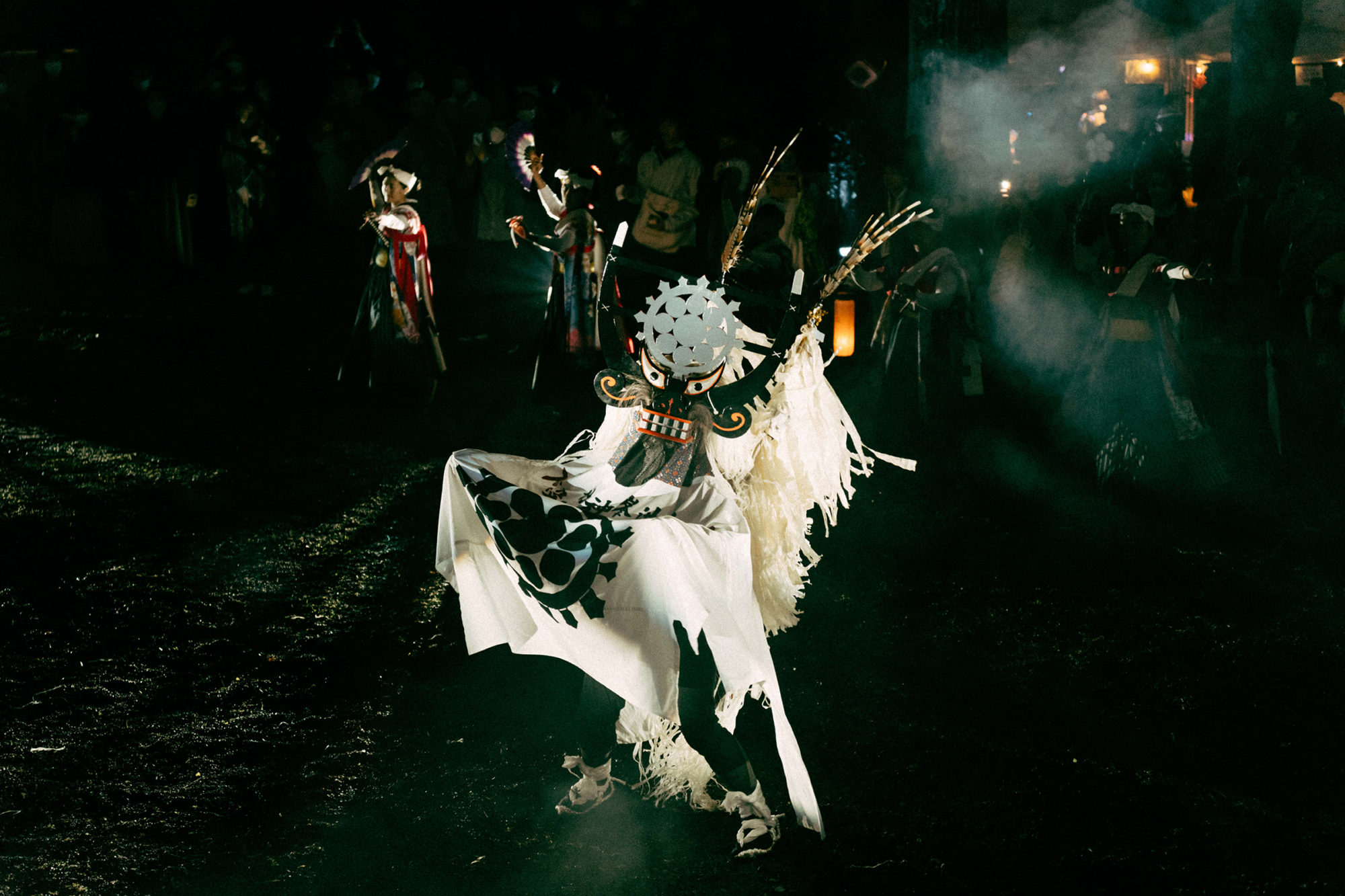

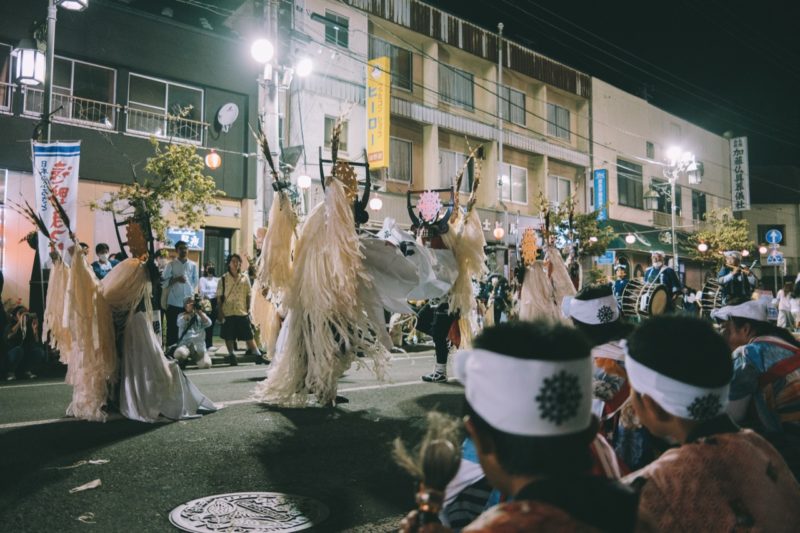
Shishi Odori is a folk tradition that has been performed for over 400 years in Tōno and across the broader Tōhoku region of northeastern Japan. Today, twelve groups remain active within Tōno City. A mystic beast, Shishi, and a human wielding a sword, Tachi, swirl and dance to the sound of drums and flute. The dance is said to express the history of conflict and harmony between nature and humanity, with movements that suggest play, combat, confrontation, and twirling, culminating in a symmetrical dance. Shishi Odori teaches us that nature cannot be controlled, but rather must be learnt from and harmonised with.
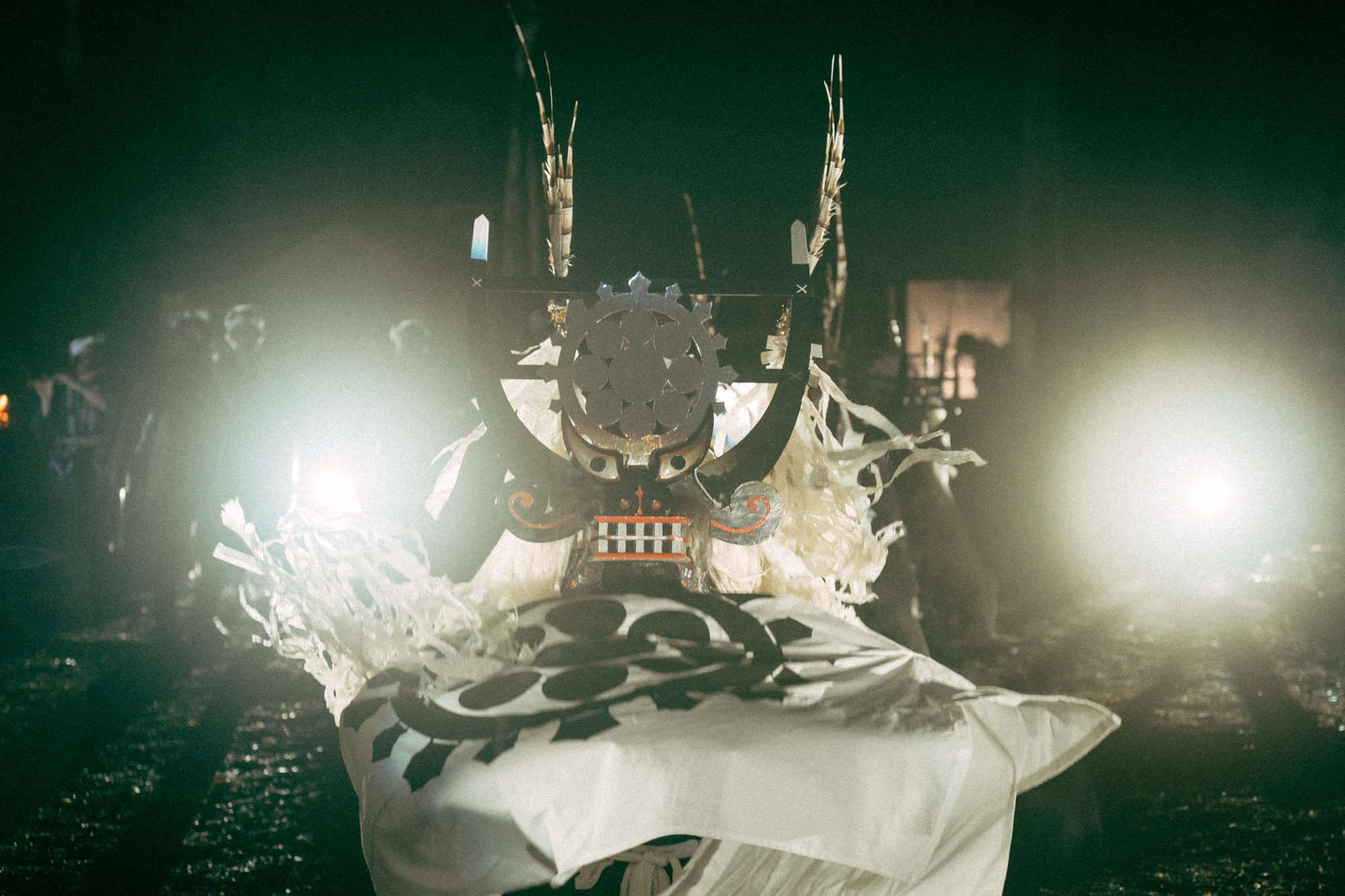
Shishi has a unique form, like a chimaera, combining parts from different beasts – the horns of a cow, eyes of a deer, nose of a dragon, and whiskers made from a horse’s tail. At the centre of the head, names of holy mountains or symbols of Shintō shrines are placed, revealing what the local people have long valued. What appears as hair is called Kannagara, the shaved fibre of trees. Just as trees have been seen as mediums of deities since ancient times, deities are said to arrive within the Kannagara. After the Shishi departs, a pile of Kannagara is left behind, thought to bring luck to those who collect it.
Shishi Odori, written in Japanese ideograms as ‘Deer Dance’ or ‘Lion Dance’, originates from hunting and mourning deer. In Tōno, hunting is conducted alone or in small groups, which differs from Matagi hunting in large groups, a style mainly practised in the neighbouring region of Akita. This relatively stronger consciousness of taking a beast’s life is thought to have influenced Tōno’s culture.
Today, with the decline in the number of hunters, the dance has become not only a memorial for beasts but also for ancestors and the deceased. In August, a time in Japan when the souls of ancestors are believed to visit the living, many Shishi Odori performances can be seen across the northeast as a ritual for repose.
Shishi Odori is a dance for reposing beasts and the deceased, performed whilst wearing the guise of a mystic beast. Why do people wear beast forms for the dance? Zoomorphism, or more specifically, beast mask culture, can be found worldwide, appearing in paintings within ancient caves. “The word ‘animal’ has only appeared in recent times,” says anthropologist Toshiaki Ishikura, further explaining that Shishi Odori spans vast dimensions of space and time, resurrecting the inner wilderness and memories from when humans, animals, and even the dead were not differentiated. The word Shishi encompasses deer, serows, and boar – a remarkably flexible concept that generally refers to four-legged animals.
Rather than distinguishing between ‘human and nature’ or ‘human and animal’, humans are beasts and a part of nature. Today, through Shishi Odori and the concept of Shishi, we can reclaim our inner wilderness and soul as many times as we wish.
RCulture Bites
1Shishi Odori
A folk tradition that arrived in Tōno four centuries ago. It is written either as “The Deer Dance” or “The Lion Dance” – as deer and lion share the same phonetics, Shishi, in Japanese. In Tōno, a mystic beast, Shishi, and a dancer with a sword perform together, suggesting that the dance expresses the antagonism and harmony between humans and nature. Shishi Odori itself is said to have begun as part of memorial services for four-legged animals, such as deer and boar, that were hunted. Today, the dance can be seen in diverse styles across northeastern Japan.

RCulture Bites
2Gonge sama
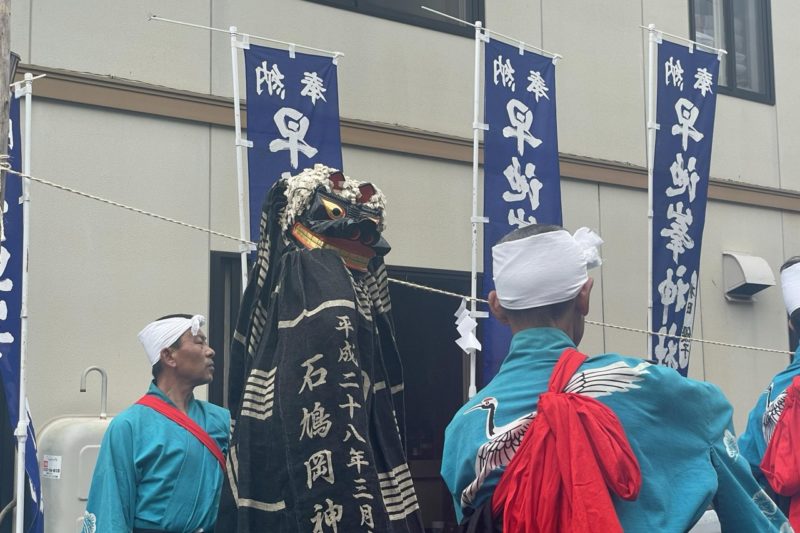
A sacred figure in the shape of a Shishi that is worshipped by Tōno’s Kagura group (Kagura being a general term for music and dance dedicated to deities). Legend tells that Gonge-sama devours fire and is known as the deity for preventing fires. During Kagura festivals, rituals to ward off misfortune are held in which participants have their heads bitten by Gonge sama.
RCulture Bites
3Tōno Festival
Every year, on a weekend in mid-September, sixty performance groups with diverse styles gather together. The sight of the town ablaze with colourful garments and lively melodies is indeed reminiscent of the otherworld.
RSite
1Hayachine Shrine
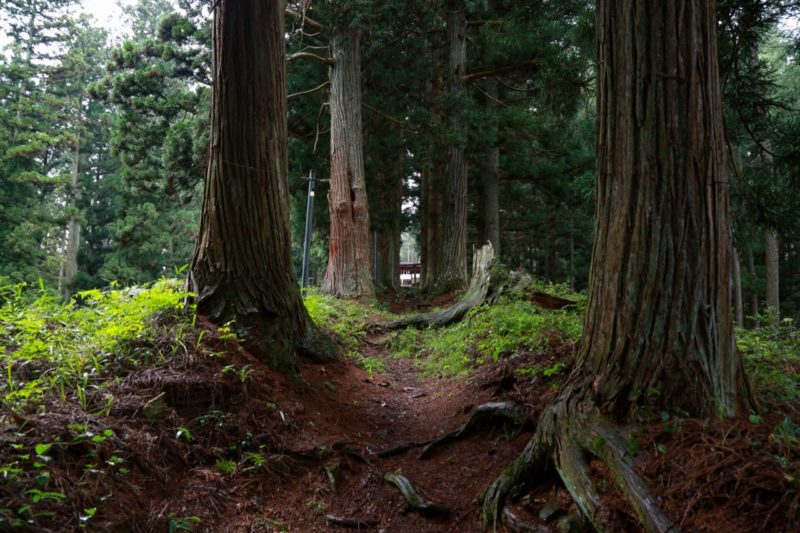
A shrine dedicated to Mount Hayachine, where the youngest sister of the deities of Tōno’s three mountains resides. Built in A.D. 806, the spacious sacred grounds are lined with enormous cedar and cypress trees, creating a distinctive atmosphere. The main deity enshrined is known as the deity of water, and it is said to always rain during the annual festival held on 17th–18th July.
Caution: The neighbouring city of Hanamaki has a shrine with the same name.

RSite
2Sugawara Shrine
A shrine built on Tenjin Hill, where Kunio Yanagita, author of “The Legends of Tōno”, witnessed the Shishi Odori whilst writing the book, describing the scene in its preface. An annual festival is held in late August, where visitors can experience the sights and sounds of this traditional festival.